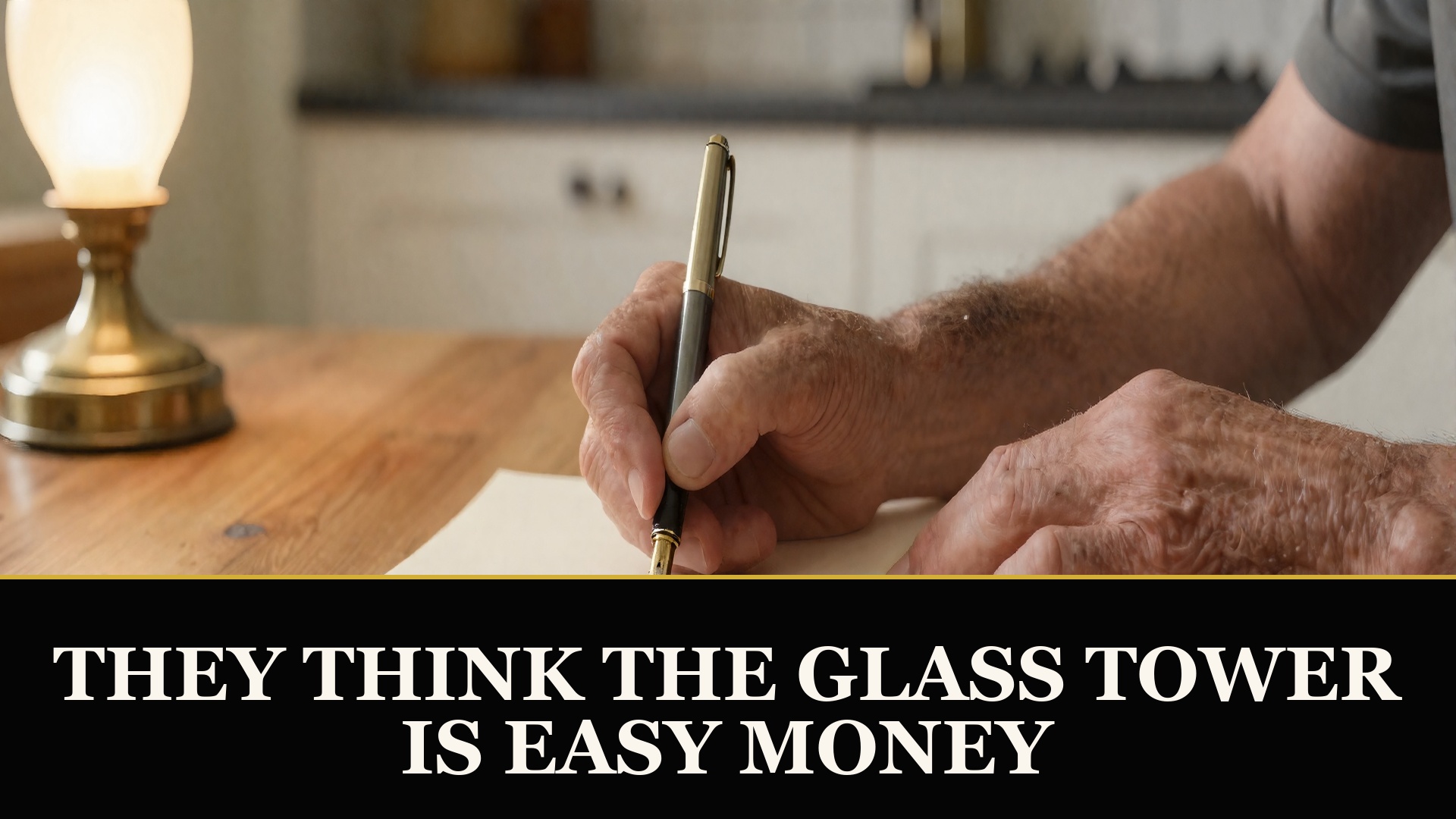
To Them, the Tower Pays You for Showing Up
You signed a forty-million-dollar acquisition before lunch. By five, the family chat was passing around Mom's forty-dollar prescription, and every thumb pointed at you. The roof, the flights, the heating oil: everything finds its way to your card.
To them, the tower pays you for showing up. You call them, and it's "Did you eat?" and "How's work?" before the ask.
It's past ten and the fluorescents hum blue over the empty floor. The only one up with you is your lanyard, reflected in the dark window.
I've flashed my own badge against that glass, midnight to six, downtown.
There's a sum I've carried for the better part of thirty-six years, and it starts with a chainsaw file. It's on the table in front of me now, next to my tea, with the rain going at the window. Mary is at the cabinets, working a soft cloth into the brass handles, the polish sharp in the air.
It's a round file, the length of a pencil, wooden handle gone dark from hands, the cross-hatching worn smooth where my thumb rides it. Thirty-six years, and it still smells of machine oil. Mary doesn't look up when I take things out of that box.
I was rooting in the wooden box on the dresser for the screwdriver this morning, and my hand closed on this instead. That's the way with old tools. I stood there a minute, and the whole of it came back.
The kettle's on its second boil, the good tea is drawn, and neither of us is in any hurry. The calculation goes back further than the kitchen—back to February of 1990, Chicago, when I was thirty-three.
The Stihl 011 ran two hundred and forty dollars, with the shipping. My money came in a brown envelope on Fridays, cash, and I did the sum on the back of a pay stub. Ten nights, midnight to six, for the Stihl 011.
I had two jobs then. Days I was on a framing crew out past O'Hare, and at midnight I started in an office tower downtown, cleaning till six. The framing paid the rent, and the tower paid for the rest; the executive floor was mine, up on forty.
My brother Liam wrote to me that February. The storms had trees down all over the home place, his old saw had given up, and there was a new Stihl in the dealer's window in Kells. He wrote it the way you'd order a part: sure the rich Yank wouldn't feel it.
Word had gone home that I was doing well in America, and I let them think it. Glass towers, they heard, and they were right about the towers. Nobody told them I was going into them after midnight with a cart and a vacuum.
I emptied bins of half-eaten lunches and newspapers, and once a pair of shoes with the tags on them. I wiped phones that had more buttons than our television, and the coffee machine in the corner made a better cup than we had at home. The boardroom table on forty was longer than our whole kitchen.
The carpet on that floor was so thick the vacuum wanted pushing both ways. There was a putter left lying in one office with a patch of fake grass for putting, and whiskey in a cabinet with a lock on it. I dusted names on doors I couldn't have pronounced.
That's the part the letters home never carried. I scrubbed tables I would never sit at, to buy a saw I would never start.
Sundays I called home, ten minutes on a phone card, my mother in the hallway with the wind around her door. She asked had I eaten and was the coat holding and how was the work, and I went to tell her about the vacuum and the putter and the bins. I said the work was steady.
I sat on the carpet of a dark office on the fortieth floor, under the blue hum of the fluorescents, with a brown pay envelope open on my knee, counting the five-dollar bills.
The tenth night fell on a Thursday. Friday after the framing shift I walked into a dealer's on the west side and bought the Stihl, and the man threw in a wedge and a bottle of chain oil. They crated it for Ireland, and I put no note in the crate.
Three weeks after, another letter came to the apartment. I knew the writing on the envelope before I saw the name. It rode in my jacket pocket through the shift, and I opened it on my break, three in the morning, sitting on the edge of a desk with the bins gathered.
Liam wrote that the saw took its time coming. He wrote it plain, the way he'd report the price of lambs. At the end he put: send a file for it, the chain's gone dull.
I read it twice, sitting there. Then I folded it into the pay envelope with the fives, and I picked up the vacuum handle.
Next Friday I went back to the dealer's and bought the file, and I put it in a drawer at the apartment, meaning to send it with a proper letter. The letter never got written. The drawer kept the file.
My mother said on a Sunday call that Liam was out every evening with the new saw. She said the place was cleared of the storm trees, near enough, and he was delighted with himself. She said it was a great job entirely.
Nobody at home asked what the saw cost. They'd have meant money.
The rain hasn't let up at the window. Mary's cloth has gone to the far cabinet and back, and the handles are shining.
Mary folds the cloth into a square and sets it on the counter. She picks the file up off the table and turns it in her hand. "Was this for Liam's saw?" she says.
"It was to go in the crate," I tell her. She nods and puts it down by my hand. The kettle comes off the boil, and she pours.
I never sent it. There was always another Friday coming, and then one year the Fridays were gone, and we were home for good. Liam never asked after the file, and I never said.
"The tea's drawn," she says, and sets the mug down in front of me. Her knuckles are slow wrapping around the handle of it. The brass behind her is clean enough to see the two of us in.
The rain goes on at the window. I've sharpened many a chain with it since, my own saws on the home farm, and the steel is worn to a shine where my thumb rides. There's no cross-hatching left in that patch.
The mug is warm under my hand, and the rain keeps at the glass. I wipe the file on my sleeve, and I put the file back in the box.
Mary is by the range with the kettle. The dog has settled by the door.
I write a letter like this every week—about the old trades, the miles between us, and the quiet things that get left behind. We send them out on Fridays so parents and their adult children have something real to hold in their hands before the Sunday phone call.
If you’d like to see what we sent out this week, the letter is open on the table below.
Open this week’s letter →